Backlinks remain one of the most important ranking factors in search engine optimization. But one question still confuses website owners:
How many backlinks do you need to rank on Google?
There is no fixed number that works for every website. Some pages rank with only a few backlinks, while others need hundreds.
In this guide, you will learn:
- The realistic number of backlinks needed
- Why quality matters more than quantity
- How competition affects backlink requirements
- How many backlinks a new website needs
- A safe strategy to build backlinks in 2026
Let’s start with a direct answer.
The Short Answer: There Is No Exact Number
If you are looking for a simple number, here is the truth:
You need more high-quality backlinks than your competitors, not a specific number.
Ranking depends on:
- Keyword competition
- Backlink quality
- Domain authority
- Content quality
- Anchor text strategy
- Link building consistency
Instead of focusing on a random number, focus on building a strong and natural backlink profile.
How Many Backlinks Do You Need to Rank for Low Competition Keywords?
For low competition keywords, you may only need:
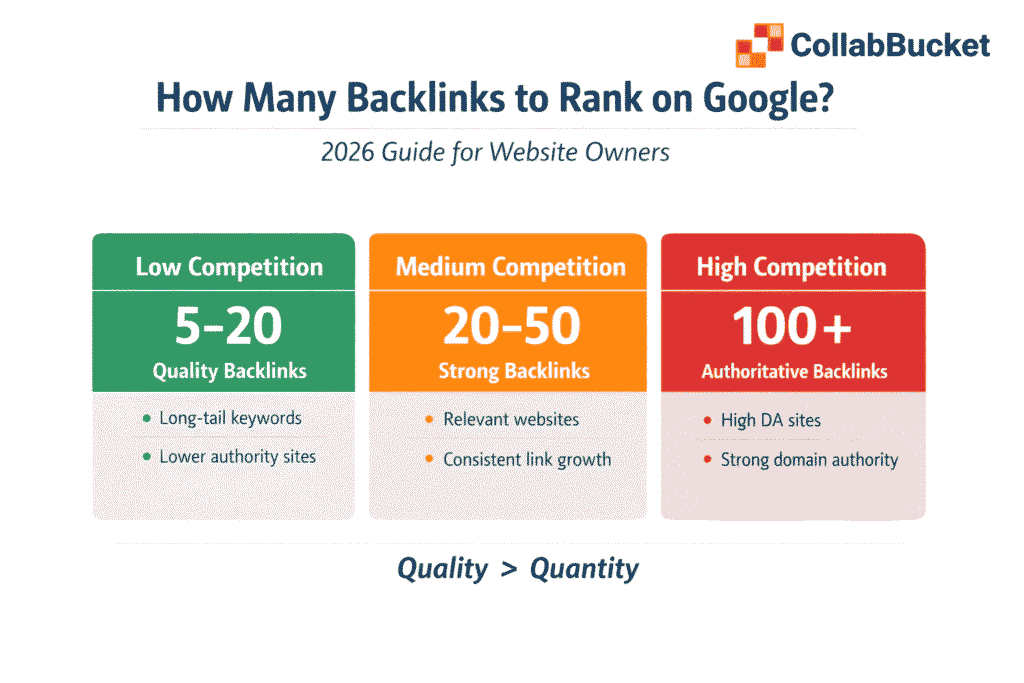
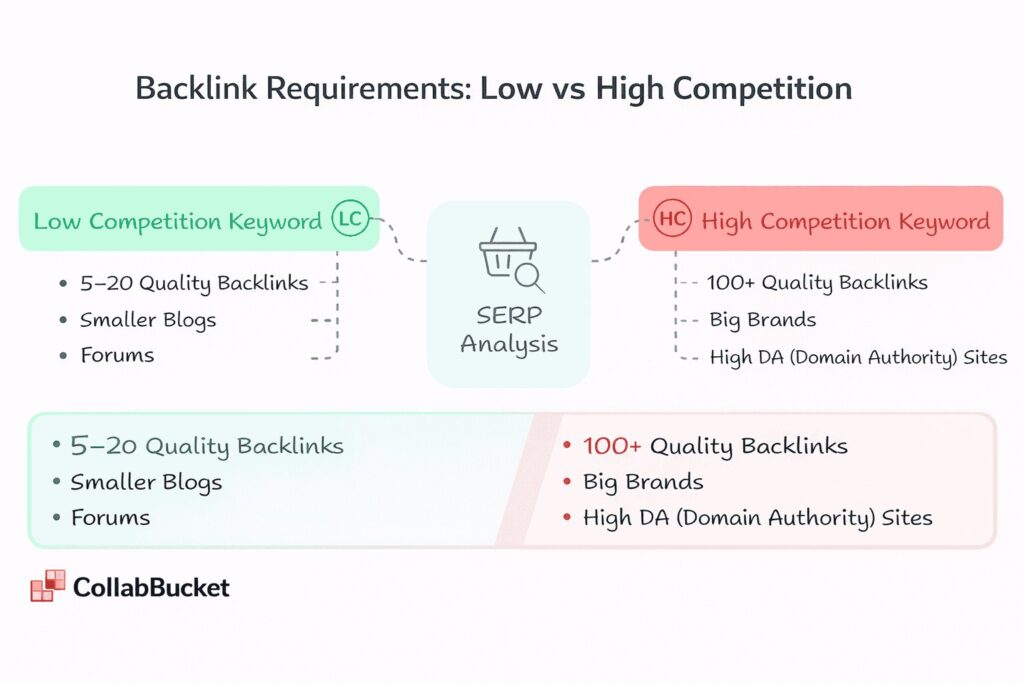
- 5 to 20 quality backlinks
- From relevant websites
- With natural anchor text
If your content is helpful and well-optimized, a small number of contextual backlinks can push your page to the first page.
This is especially true for long-tail keywords.
How Many Backlinks Are Needed for Medium Competition?
For medium competition keywords, you may need:
- 20 to 50 quality backlinks
- A mix of guest posts and contextual links
- Links from websites with real organic traffic
At this level, backlink quality becomes more important than quantity. Ten strong backlinks from relevant sites are better than fifty weak ones.
High Competition Keywords Need Strong Authority
If you target competitive keywords, especially in niches like finance, SaaS, or marketing, you may need:
- 100+ backlinks
- Links from high authority websites
- Consistent link velocity
- A strong overall backlink profile
In competitive niches, it is not just about the number of backlinks. It is about the strength of the websites linking to you.
Backlink Quality vs Quantity
Many beginners believe more backlinks automatically improve rankings. This is not true.
Google evaluates:
- Relevance
- Authority
- Link placement
- Anchor text
- Spam signals
One high-quality contextual backlink can be more powerful than twenty low-quality links.
Instead of asking, “How many backlinks do I need?”, ask:
“Are my backlinks helping my authority?”
How Many Backlinks Does a New Website Need?
If your website is new, you should build backlinks slowly and naturally.
For new websites:
- Start with 5–10 quality backlinks in the first month
- Focus on branded anchors
- Avoid aggressive exact match anchors
- Maintain steady link velocity
New domains do not need hundreds of backlinks immediately. Sudden link spikes can look unnatural.
A slow and steady approach builds trust.
Can You Rank Without Backlinks?
For very low competition keywords, it is possible to rank with strong on-page SEO and helpful content.
However, in most niches, backlinks are necessary to reach the top positions. Search engines use backlinks as trust signals. If other websites link to you, it shows that your content has value. Without backlinks, ranking for competitive terms becomes difficult.
How Long Do Backlinks Take to Work?
Backlinks do not improve rankings instantly.
Usually:
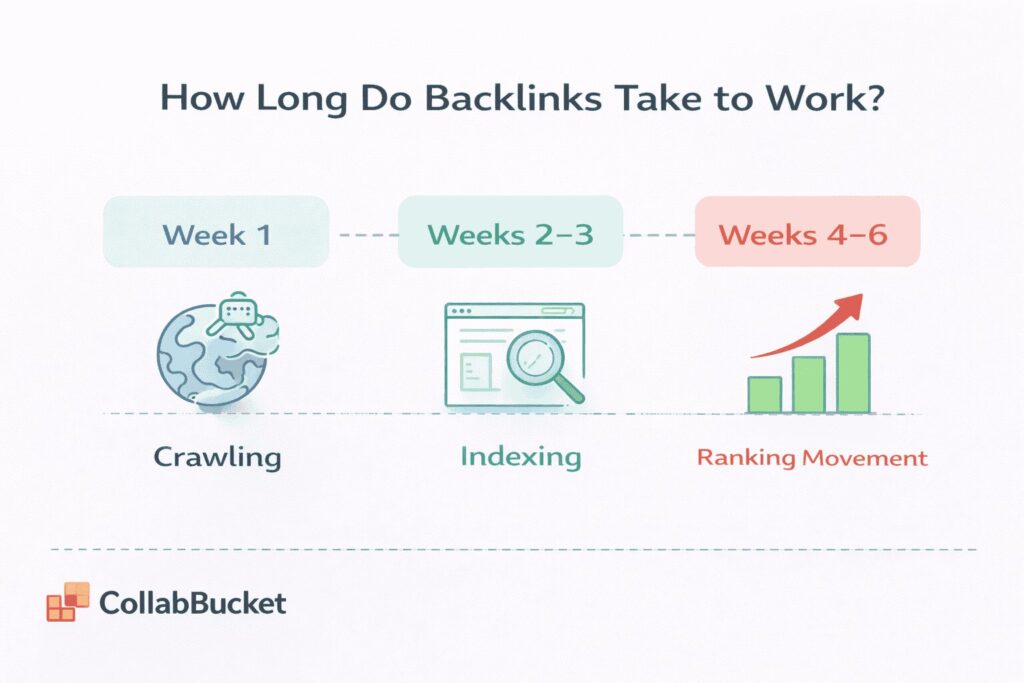
- It takes 2–6 weeks to see movement
- Strong backlinks may show impact faster
- New websites may take longer
Backlinks need time to be crawled, indexed, and evaluated by search engines.
Patience is important in SEO.
Factors That Decide the Number of Backlinks Needed
Here are the main factors that influence how many backlinks you need to rank:
1. Keyword Difficulty
High difficulty keywords require more authority and more backlinks. Low difficulty keywords need fewer links.
Keyword difficulty is determined by how strong the websites ranking on the first page already are. If the top results are established brands with high domain authority and hundreds of referring domains, you will need a stronger backlink profile to compete.
On the other hand, if smaller blogs with limited backlinks are ranking, you can achieve results with fewer but high-quality links.
Keyword difficulty is usually influenced by:
- The number of referring domains pointing to top-ranking pages
- The authority of competing domains
- The quality of their backlink profiles
- The overall competitiveness of the niche
Before building backlinks, always analyze the first page of Google. Study how many referring domains competitors have and evaluate the strength of their content. This helps you estimate how many backlinks you realistically need instead of guessing.
2. Competitor Backlink Profile
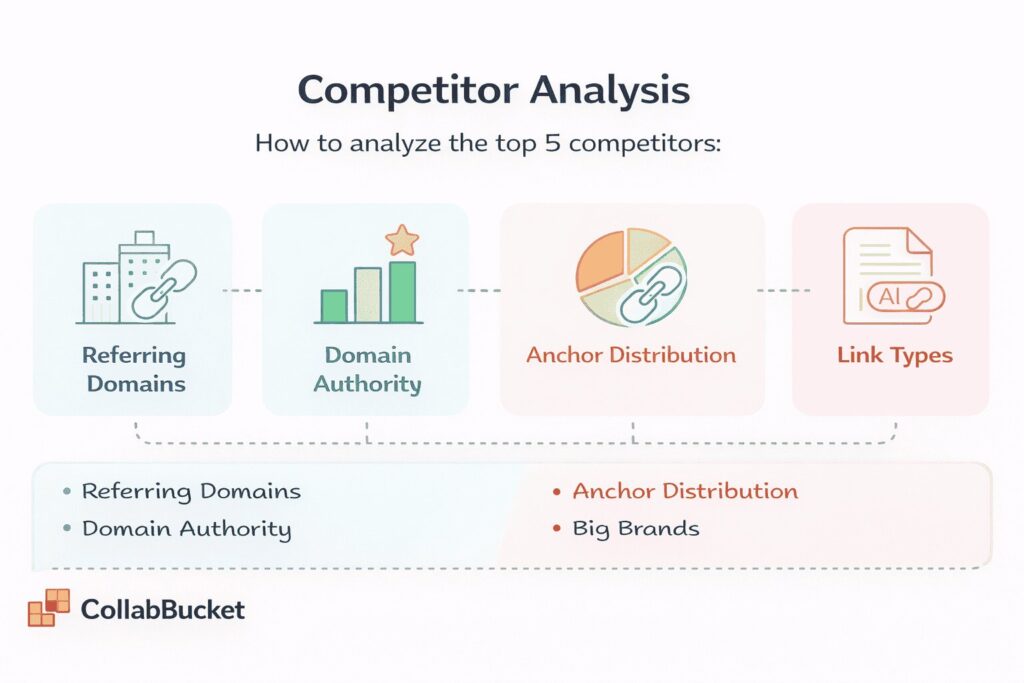
Check the top 5 ranking pages:
- How many referring domains do they have?
- What is their domain authority
- Are they getting contextual backlinks?
Your goal is not to copy competitors exactly, but to understand the level of authority required to compete.
If the top-ranking pages have 30–40 referring domains, you know you need to build at least a comparable number of high-quality links. If they have 200+ referring domains from authoritative websites, the competition is much stronger.
Also, pay attention to link quality. A competitor with fewer but highly relevant backlinks may be harder to beat than a site with many low-quality links.
Competitor analysis helps you build a smart strategy instead of guessing how many backlinks you need.
3. Content Quality
If your content is better than your competitors, you may need fewer backlinks to rank.
Search engines do not evaluate backlinks alone. They also analyze how helpful, relevant, and complete your content is. If your page fully satisfies user intent, it can compete with fewer links compared to weaker content.
Better content includes:
- Clear and simple explanations
- Updated and accurate information
- Practical examples that improve understanding
- Logical structure with proper headings
- Short paragraphs for better readability
- Useful insights that competitors have not covered
When your content answers the search query better than others, search engines may reward it with higher rankings — even if you have fewer backlinks.
In many cases, improving content quality is more cost-effective than building large numbers of links. Strong content combined with steady link building creates the best long-term results.
Search engines reward helpful content that provides real value to users.
4. Anchor Text Strategy
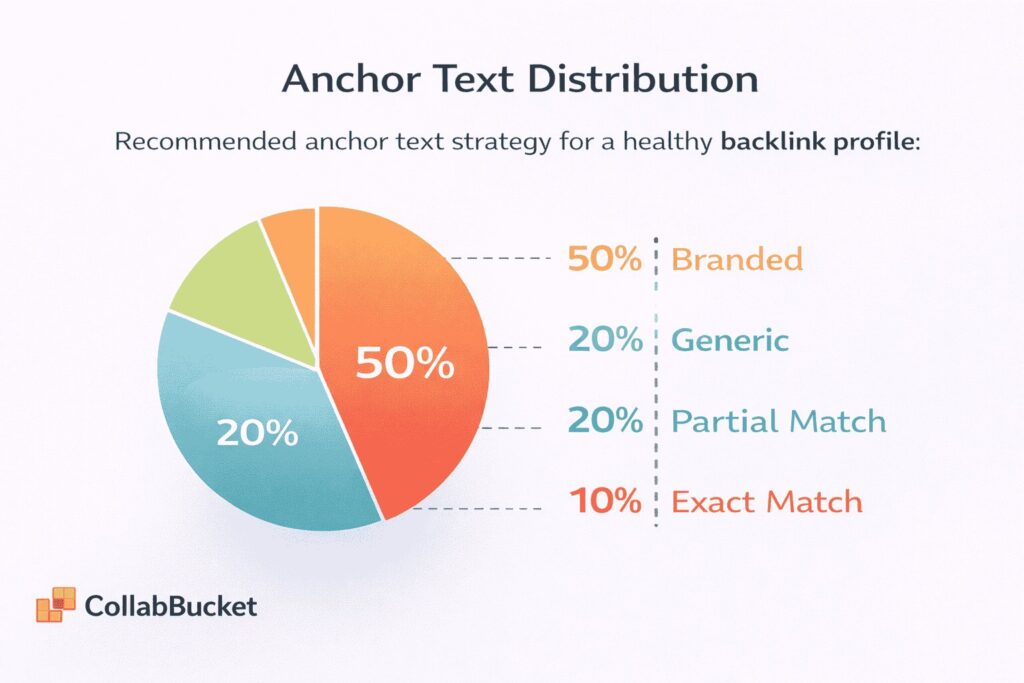
Anchor text affects ranking power because it helps search engines understand what your page is about.
However, using the right anchor text strategy is important. An unnatural anchor profile can create ranking risk instead of improving performance.
A natural backlink profile usually includes:
- Branded anchors (your website or brand name)
- Generic anchors (such as “click here” or “read more”)
- Partial match keywords
- URL anchors
- A small percentage of exact match keywords
The goal is to maintain balance. If most of your backlinks use the exact same keyword as anchor text, it can look manipulative to search engines.
Instead of aggressively targeting exact match anchors, focus on building a diverse and natural anchor distribution. This improves long-term ranking stability and reduces the risk of penalties.
A smart anchor text strategy strengthens your backlink profile and supports sustainable SEO growth.
5. Link Relevance
Link relevance plays a major role in how powerful a backlink is.
Search engines evaluate not only the number of backlinks you have, but also how closely related those linking websites are to your niche. A backlink from a relevant website carries more weight than a link from an unrelated source.
For example:
- An SEO blog linking to an SEO website is highly relevant.
- A finance website linking to a travel blog may have less impact if there is no topical connection.
Relevant backlinks send a stronger trust signal because they show that your content is valuable within your industry.
Relevance can be determined by:
- The overall niche of the linking website
- The topic of the specific page linking to you
- The context in which your link is placed
- The surrounding content of the link
Contextual links placed naturally inside related content are usually more powerful than links in footers, sidebars, or unrelated articles.
Building backlinks from relevant websites improves ranking potential and strengthens your topical authority over time.
A Safe Backlink Strategy for 2026
Instead of chasing numbers, follow this structure:
Step 1: Target Low Competition Keywords First
Build early wins.
Ranking small keywords builds domain strength.
Step 2: Focus on Contextual Backlinks
Contextual backlinks placed inside relevant content are more valuable.
Guest posting on niche websites is one safe way to build these links consistently.
Step 3: Maintain Link Velocity
Do not build 50 backlinks in one week and then stop.
Consistency is better than spikes.
Example:
- 5–10 backlinks per month
- Steady growth
- Balanced anchor distribution
Step 4: Improve Overall Authority
Backlinks work best when combined with:
- Strong internal linking
- Helpful blog content
- Good on-page SEO
- Regular publishing
SEO works as a system, not a single tactic.
Common Mistakes to Avoid
When trying to rank faster, many website owners:
- Buy low-quality backlinks
- Focus only on domain authority
- Ignore organic traffic
- Use aggressive anchor text
- Build links too quickly
These mistakes can slow your growth instead of improving rankings.
Practical Example
Imagine two websites targeting the same keyword.
Website A:
- 40 low-quality backlinks
- Poor content
- Irrelevant anchor text
Website B:
- 12 high-quality contextual backlinks
- Helpful content
- Natural anchor profile
In most cases, Website B will rank higher.
This shows that backlink quality matters more than raw numbers.
Final Answer: How Many Backlinks Do You Need to Rank?
There is no fixed number.
For low competition keywords:
5–20 quality backlinks may be enough.
Medium competition keyword:
20–50 strong backlinks.
For high competition keyword:
100+ authoritative backlinks plus strong domain authority.
The real goal is simple:
Build more relevant and higher-quality backlinks than your competitors.
Conclusion
If you are wondering how many backlinks you need to rank on Google, remember this:
Focus on quality, relevance, and consistency.
Backlinks are important, but they must be:
- Natural
- Contextual
- From real websites
- Built steadily
SEO success does not come from chasing large numbers. It comes from building authority step by step.
When you combine strong content with a smart link building strategy, rankings improve naturally over time.