

Backlinks remain an important ranking factor in search engine optimization. However, the strength of a backlink does not depend only on whether it is dofollow or nofollow. The clickable words inside a link — known as anchor text — help search engines understand the meaning, relevance, and relationship between pages.
In 2026, searchengines evaluate anchor text patterns more carefully than before. Repeating the same keyword-rich anchors can create imbalance. A natural and balanced anchor text profile supports steady rankings and long-term SEO growth.
This guide explains how anchor text works, the different types, ideal distribution patterns, common mistakes, and a safe strategy for optimization.
What Is Anchor Text in SEO?
Anchor text is the clickable text in a hyperlink.
Example: <a href=”https://example.com/seo-guide”>SEO strategy guide</a>
In this example, “SEO strategy guide” is the anchor text.
Search engines use anchor text to understand:
- What the linked page is about
- How it relates to the referring page
- Whether the link appears natural
- The context surrounding the link
Anchor text acts as a contextual signal. When used naturally within relevant content, it supports topical alignment. When used aggressively or repetitively, it may create imbalance.
Why Anchor Text Optimization Matters in 2026
Search engines do not evaluate backlinks individually only. They analyze patterns across the entire backlink profile.
Anchor text helps search engines:
- Associate keywords with specific pages
- Understand topical authority
- Detect unnatural link-building behavior
- Evaluate editorial intent
From practical outreach campaigns across marketing and SaaS websites, balanced anchor distribution tends to produce more stable ranking growth compared to heavy exact-match strategies. In projects where exact-match anchors exceeded 15–20%, ranking fluctuations were more common. After shifting toward branded and partial match anchors, performance became more stable over time.
This shows that anchor text optimization is not about inserting keywords everywhere. It is about creating a natural mix that reflects how real websites link to useful content.
Types of Anchor Text
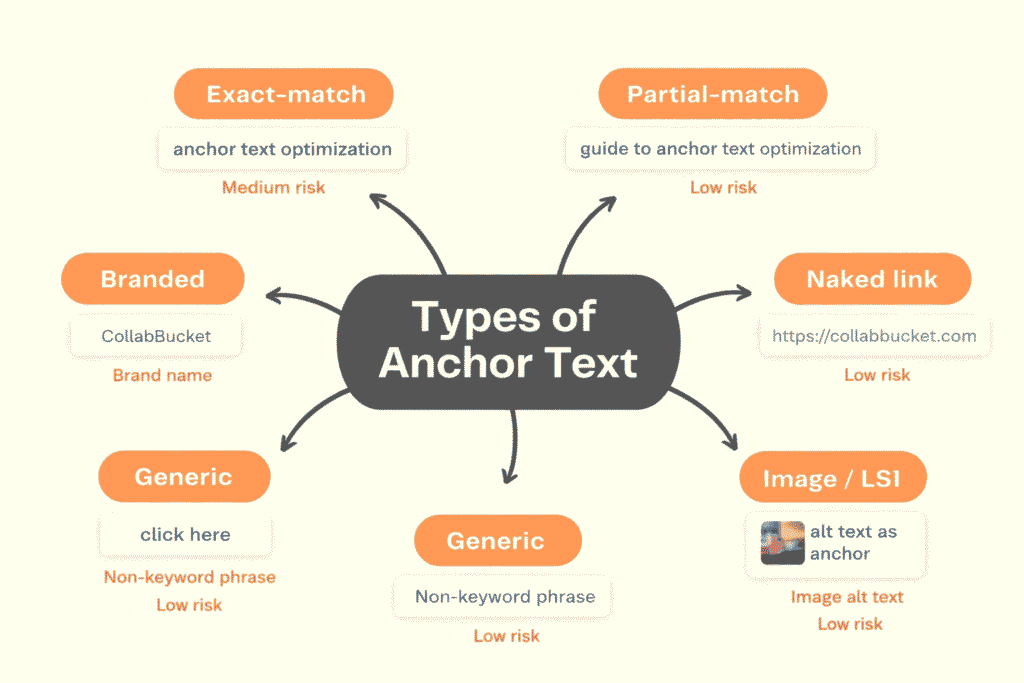
Understanding anchor categories helps you build a safer SEO strategy.
1. Exact Match Anchor Text
This matches your target keyword exactly.
If your keyword is “anchor text optimization,” the anchor text would be: – “anchor text optimization“
Exact match anchors reinforce relevance. However, overuse can create risk.
2. Partial Match Anchor Text
This includes variations of your main keyword.
Examples:
- guide to anchor text optimization
- safe anchor text strategy
- improving anchor distribution
Partial match anchors appear more natural and are generally safer than repeated exact match anchors.
3. Branded Anchor Text
This uses your brand name.
Examples:
- CollabBucket
- CollabBucket SEO blog
- CollabBucket link building services
Branded anchors are essential in a healthy backlink profile. They build trust and support long-term authority.
4. Naked URL Anchor
This displays the full URL.
Example: https://collabbucket.com/
These are common in references, citations, and resource pages.
5. Generic Anchor Text
Non-keyword phrases such as:
- click here
- read more
- this guide
- learn more
Generic anchors help diversify the anchor profile.
6. Image Anchor Text
When an image links to another page, the alt text functions as anchor text. Clear and descriptive alt text supports both accessibility and SEO.
Ideal Anchor Text Distribution for 2026
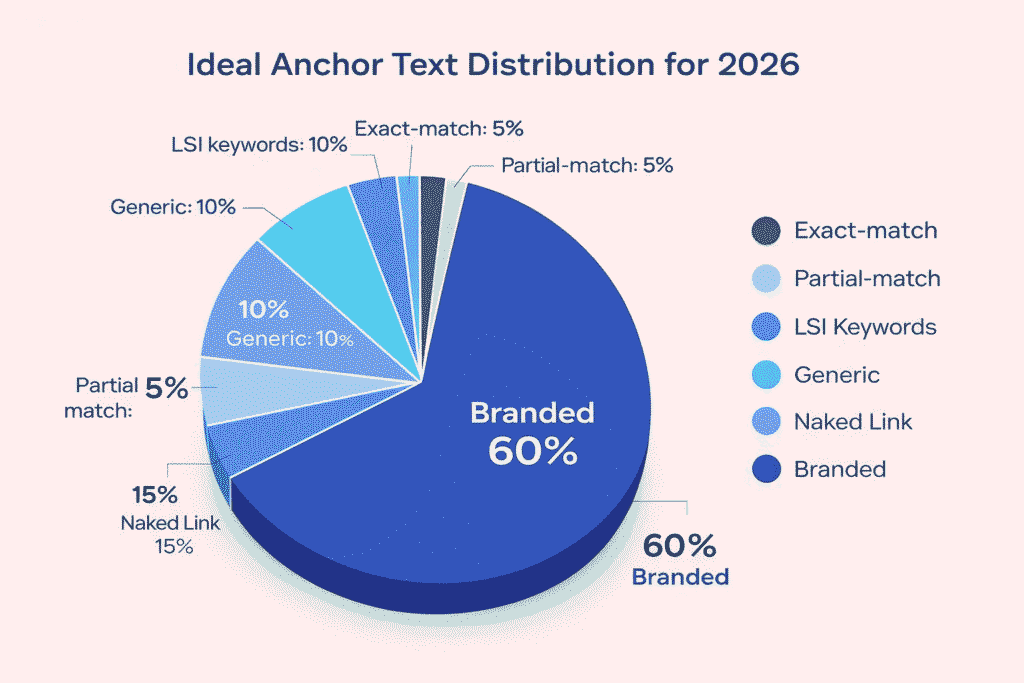
There is no universal formula, but a balanced anchor text profile often follows this general structure:
- 50–70% Branded anchors
- 10–20% Partial match anchors
- 5–10% Exact match anchors
- 10–15% Generic and naked URLs
The ideal distribution depends on:
- Industry competition
- Domain age
- Existing backlink profile
- Link acquisition speed
For newer websites, building a strong branded foundation first is usually safer. In competitive niches, aggressive exact match anchors often lead to instability.
The key principle is gradual and diversified growth.
How Search Engines Evaluate Anchor Context
Modern algorithms analyze more than just anchor keywords. They evaluate:
- Surrounding paragraph relevance
- Page topic alignment
- Website authority
- Link placement within the article
- Natural language patterns
A keyword-rich anchor placed inside unrelated content carries limited value. In contrast, a partial match anchor placed inside a highly relevant article strengthens contextual signals.
Search engines also analyze semantic relationships. If the surrounding content discusses related concepts, entities, and topics, the link appears more natural.
In 2026, contextual alignment matters as much as anchor wording itself.
Common Anchor Text Mistakes to Avoid
Most anchor-related issues come from patterns rather than individual links.
A. Overusing Exact Match Anchors
Repeating the same keyword across many referring domains can create imbalance. A natural backlink profile rarely contains identical anchor phrases repeatedly.
B. Ignoring Branded Anchors
A strong brand presence in your anchor distribution supports credibility. Very low branded anchors may appear unnatural.
C. Forcing Keywords into Guest Posts
Anchor text should fit naturally within a sentence. If it feels inserted only for SEO purposes, it reduces content quality.
D. Sudden Anchor Pattern Shifts
A rapid increase in keyword-rich anchors within a short period may signal manipulation.
E. Low-Relevance Link Placement
Even well-optimized anchor text has limited value when placed on irrelevant websites or pages.
Safe Anchor Text Strategy for Guest Posting
Guest posting remains an effective way to earn contextual backlinks when done responsibly.
Best practices include:
- Prioritize branded anchors in most placements
- Use partial match anchors within natural sentences
- Avoid repeating the same anchor phrase
- Ensure the surrounding paragraph supports the linked topic
- Focus on editorial quality before anchor placement
For example, instead of writing:
best anchor text optimization service
A more natural approach would be:
practical methods for improving anchor text strategy
The second version fits better within educational content and maintains natural flow.
When guest posts provide genuine value, anchor text blends naturally into the article.
Anchor Text Optimization for Internal Linking
Internal anchor text also plays an important role in SEO.
Best practices:
- Use descriptive and relevant anchor text
- Avoid repeating the same internal anchor across many pages
- Support topic clusters with contextual links
- Link to important pages using varied anchor phrases
Internal linking helps search engines understand your site structure and content hierarchy. Balanced internal anchors support external link-building efforts.
How to Audit Your Anchor Text Profile

Regular monitoring helps maintain stability.
You can use tools such as:
Simple audit process:
- Export your anchor text report
- Categorize anchors into brand, partial, exact, and generic
- Calculate percentage distribution
- Identify heavy concentration areas
- Adjust future outreach strategy accordingly
If exact match anchors exceed safe levels, shift focus toward branded and partial match anchors in upcoming campaigns.
Anchor audits every few months help prevent long-term imbalance.
Practical Example of Anchor Distribution Adjustment
In one marketing website campaign, the initial anchor profile showed:
- 22% exact match
- 18% partial match
- 40% branded
- 20% generic
Ranking performance showed fluctuations for competitive terms.
After adjusting the outreach strategy to prioritize branded and partial anchors, the profile shifted closer to:
- 8% exact match
- 20% partial match
- 60% branded
- 12% generic
Over time, the ranking movement became more stable and gradually improved.
This example demonstrates how balanced anchor text optimization supports steady growth.
Anchor Text and Topical Authority
Anchor text contributes to topical authority when multiple relevant websites link using varied but related phrases.
Instead of repeating one keyword, encourage natural variations such as:
- link building strategy
- safe backlink practices
- contextual link placement
- anchor diversification methods
This builds semantic strength without keyword stuffing.
Final Thoughts
Anchor text optimization in 2026 focuses on balance, context, and gradual development.
A sustainable strategy includes:
- Building strong branded signals
- Using partial match anchors naturally
- Limiting exact match repetition
- Maintaining contextual relevance
- Monitoring distribution regularly
Search engines evaluate anchor diversity, topical alignment, editorial placement, and growth patterns together. When anchor text supports valuable content and genuine outreach, ranking improvements tend to remain stable over time.
A balanced anchor text strategy strengthens authority, visibility, and long-term SEO performance in a safe and sustainable way.